
10 Common Accounting Mistakes Startups Make (And How to Avoid Them)
TL;DR — the 30-second version
• Most startup accounting errors come from mixing money, late books, and missed GST/TDS deadlines — not fraud.
• A messy ledger is the No. 1 reason GST notices and ITC reversals land in your inbox.
• Use accrual books, reconcile your bank every month, and never miss a return date.
• Fixing the basics early is cheaper than fixing them under audit later.
Why accounting mistakes quietly kill good startups
You built a great product. You closed a few clients. Money is moving. But here is the hard truth: most startups do not fail because the idea was bad. They fail because the money was not tracked.
Poor record-keeping, mixed-up bank accounts, and missed tax dates pile up fast. By the time a founder notices, the cost is real — penalties, blocked input tax credit, and a due-diligence mess that scares away investors.
This guide lists the 10 most common accounting mistakes startups make in India, with plain fixes and real rupee numbers. It works for early-stage founders and small business (SME) owners alike. Clean books are not red tape. They are your runway.
1. Mixing personal and business money
This is the most common mistake of all. You pay a vendor from your personal UPI. You buy office chairs on your own card. It feels fast. It is also a trap.
Your company is a separate legal entity. When personal and business cash mix, your profit is wrong, your tax filing is risky, and an investor doing diligence sees a red flag. Open a dedicated current account on day one and route every rupee through it.
:check_mark_button: Founder tip: Pay yourself a fixed monthly amount from the business account. Treat the company like a stranger you owe money to — it keeps the line clean.
2. Skipping bookkeeping in the early months
"We will sort the books later" is a costly line. Invoices go missing. Cash receipts are forgotten. Three months later, no one can rebuild what happened.
Bookkeeping is just recording every transaction on time — sales, expenses, and bank movement. Do it weekly from month one. If it feels like a distraction from building, hand it off. Reliable bookkeeping services cost far less than the penalties and lost tax credit that sloppy books create.
3. Using cash-basis books when accrual is the norm
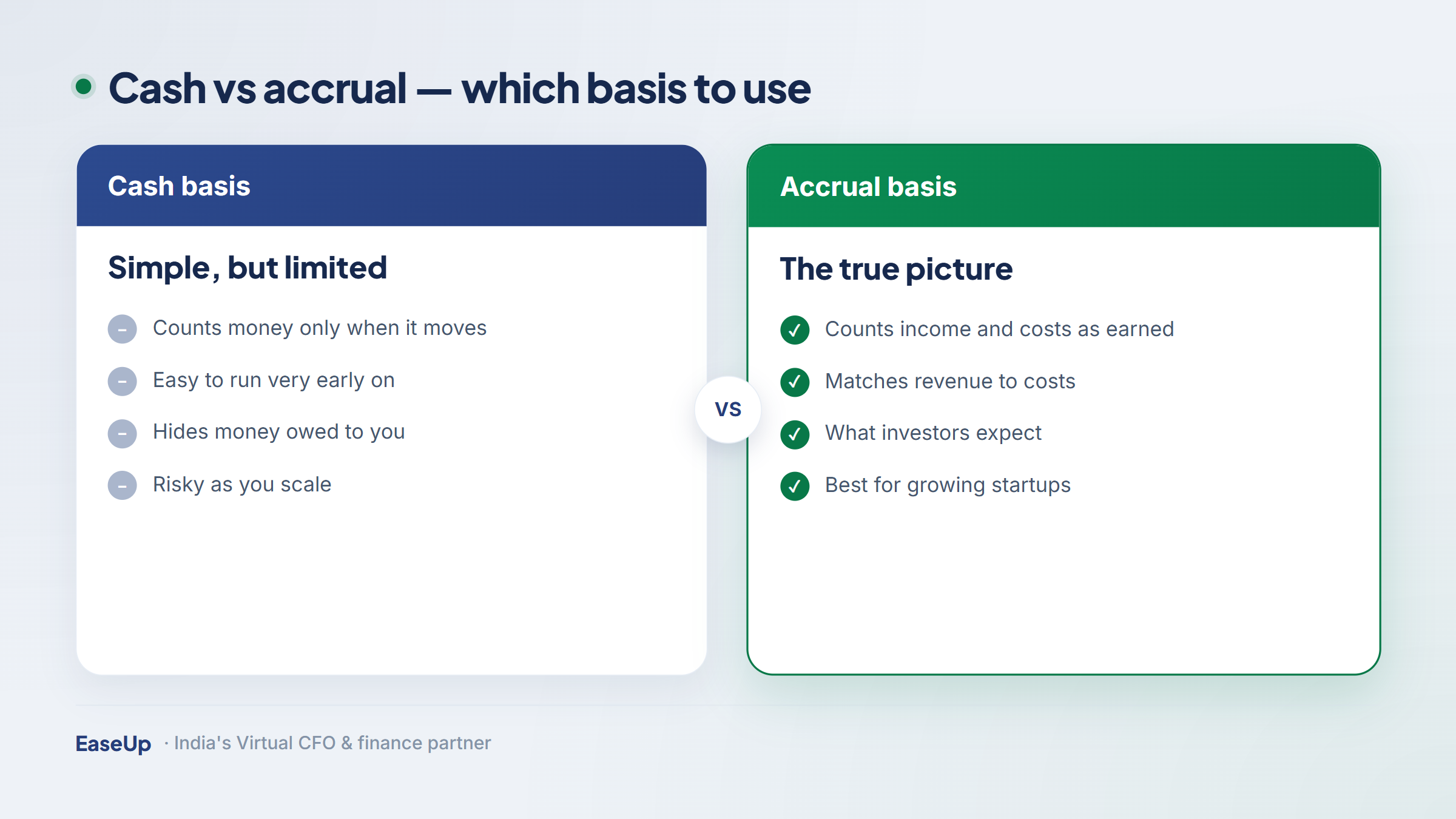
Many founders record income only when cash hits the bank. That is cash-basis accounting. It is simple, but it hides the real picture.
Indian accounting standards expect accrual books: you record a sale when you raise the invoice, not when you get paid. Accrual shows what you actually earned and what you are owed. It also keeps your GST and income tax numbers in sync.
 Watch out: Booking sales before you ship or invoice inflates revenue. Record income only after the invoice is raised and the goods or service are delivered.
4. Getting GST registration and filing wrong
GST trips up more startups than any other tax. The two big errors: registering too late, and filing returns that do not match.
You must register once your turnover crosses the threshold — Rs 40 lakh for goods and Rs 20 lakh for services (lower in some special-category states). After that, your monthly returns must agree with each other. Check the live rules on the official GST portal before you assume.
The classic slip is a mismatch between your sales return and your summary return. That gap is exactly what triggers a notice.
GST return | What it reports | Common startup error |
GSTR-1 | Outward sales, invoice by invoice | Missed or late invoices |
GSTR-3B | Summary of tax payable and ITC claimed | Does not match GSTR-1 |
GSTR-2B | Auto-drafted input tax credit (ITC) | Claiming ITC not reflected here |
5. Ignoring TDS until it becomes a penalty
Tax Deducted at Source (TDS) means you cut a small slice of tax when you pay vendors, rent, or salaries, and deposit it with the government. Many startups simply forget.
Miss it and the cost stacks: interest on late deposit, late-filing fees, and an expense the tax office may disallow. File your quarterly TDS returns on time and download the rules from the Income Tax e-filing portal.
TDS slip-up | Rough cost (illustrative) | How to avoid |
Late deposit of TDS | Interest at 1.5% per month on the amount | Deposit by the 7th of the next month |
Late filing of TDS return | Rs 200 per day (capped at the TDS amount due) until you file | Calendar the quarterly due dates |
No TDS deducted at all | 30% of the expense disallowed 100% disallowed for payments to non-residents without TDS | Deduct at the right rate before paying |
Figures are illustrative and rounded. Confirm current rates and limits before you act.
6. Treating capital costs as everyday expenses
Buying a laptop is not the same as paying the electricity bill. One is a capital asset you use for years; the other is a running cost for the month.
Lump them together and your profit is wrong, your tax is wrong, and your balance sheet does not reflect what you own. Capitalise big, long-life purchases and claim depreciation. Expense the small, recurring stuff.
 Note: A quick rule of thumb: if it gives value for more than a year, it is usually a capital asset, not an expense. When in doubt, ask your accountant.
7. Never reconciling the bank account
Your books say one number. Your bank statement says another. If you never compare the two, errors and missing entries hide for months.
Bank reconciliation is a 20-minute monthly habit: match every entry in your books to the bank. It catches duplicate charges, missed income, and fraud early. A founder who reconciles every month sleeps better.
8. Flying blind on cash flow and runway
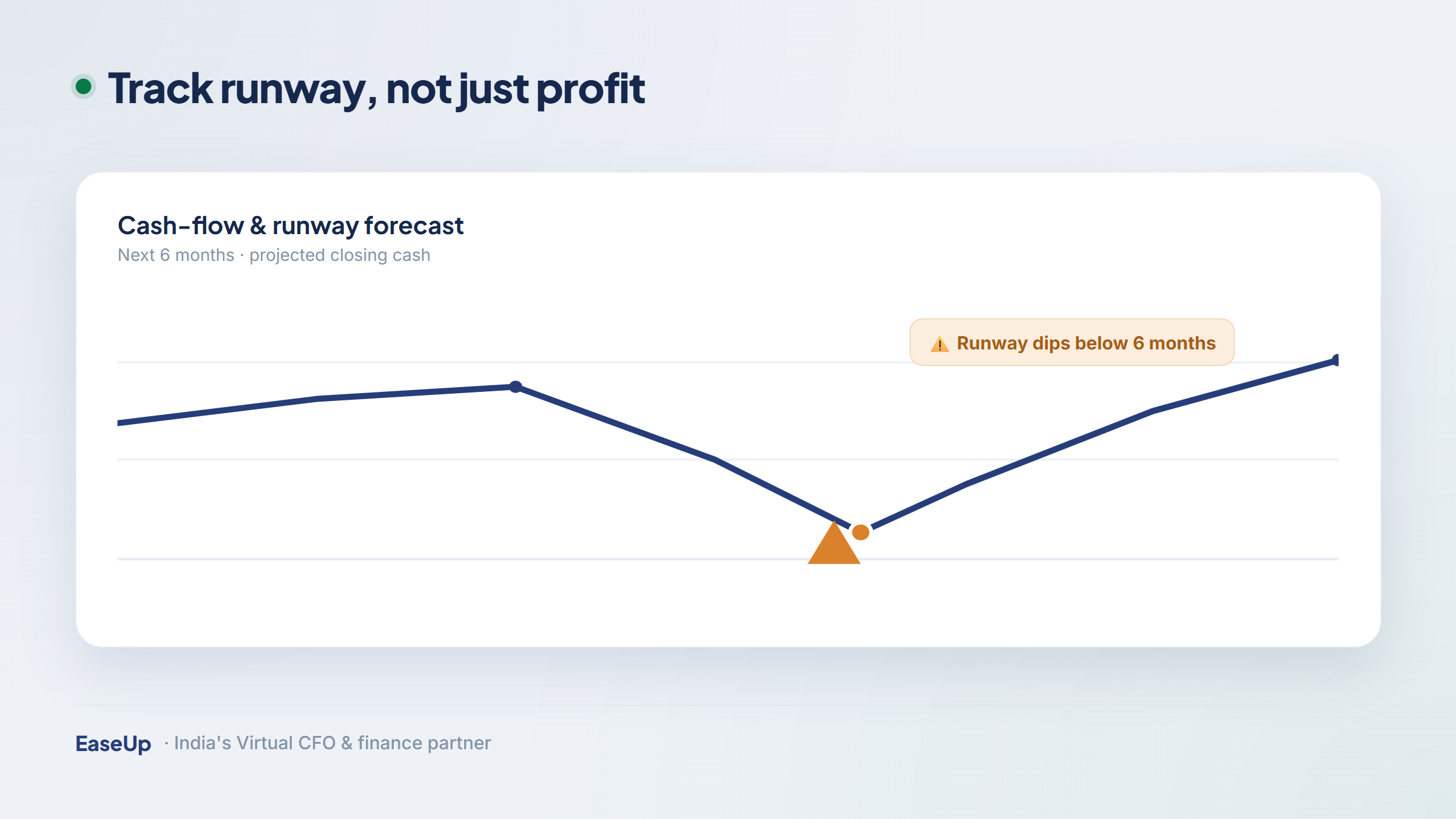
Profit on paper does not pay salaries. Cash does. Plenty of growing startups run out of money while their profit-and-loss statement looks fine.
Track a simple cash-flow forecast: money in, money out, and how many months of runway you have left. Aim to see at least 90 days ahead. A virtual CFO can build this view so you raise or cut costs before it gets tight.
:check_mark_button: Founder tip: Update your runway number on the first working day of every month. One habit, fewer nasty surprises.
9. Missing ROC and company-law deadlines
Once you incorporate a private limited company, the Registrar of Companies (ROC) expects annual filings — even if you made no money yet. Founders busy with product forget, and the late fees are brutal.
Late ROC filings carry a penalty of Rs 100 per day, per form, with no upper cap on some filings — and repeated default can disqualify directors. Keep a compliance calendar and check requirements on the Ministry of Corporate Affairs portal.
10. Doing it all alone, too long
In the first months, the founder is the accountant. That is fine. But as deals, invoices, and headcount grow, DIY books start to crack. Errors creep in exactly when the stakes rise.
You do not need a full finance team on day one. You need the right help at the right time — a bookkeeper for the daily entries and strategic virtual CFO support for the decisions. New founders can also explore benefits on Startup India.
A simple monthly money routine for founders
You do not need to be an accountant. You need a rhythm. Here is a founder-friendly checklist you can run every month.
Record everything. Log all sales and expenses through the business account only.
Reconcile the bank. Match your books to the bank statement, line by line.
Check GST. Make sure your sales return and summary return agree.
Deposit TDS. Pay it by the 7th of the next month, every time.
Update runway. Refresh your 90-day cash-flow view and act early.
How EaseUp keeps your books audit-ready
EaseUp is built for Indian founders and SME owners who would rather build than chase ledgers. We set up clean, accrual-based books, file GST and TDS on time, and keep your ROC calendar honest.
Whether you need day-to-day bookkeeping or a fractional finance partner, we make the numbers boring — in the best way. No surprises, no last-minute panic, just books that hold up under any audit or diligence.
Frequently asked questions
Mixing personal and business money is the most common mistake. Founders pay vendors from personal accounts or buy company items on personal cards. This makes profit figures wrong, complicates tax filing, and raises a red flag during investor due diligence. The fix is simple: open a dedicated business current account on day one and route every rupee through it.
A startup must register for GST once turnover crosses the threshold — broadly Rs 40 lakh for goods and Rs 20 lakh for services, with lower limits in some special-category states. You also need to register if you sell across state lines or on e-commerce platforms in many cases. Always confirm the current limits on the official GST portal before deciding.
Accrual accounting is the expected norm under Indian accounting standards. Under accrual, you record income when you raise the invoice and expenses when you incur them, not when cash moves. This gives a true picture of what you earned and owe, and keeps your GST and income tax numbers consistent. Cash-basis is simpler but hides receivables and payables.
Missing Tax Deducted at Source (TDS) deadlines brings interest on late deposit and a late-filing fee, and the expense may be partly disallowed. Missing Registrar of Companies (ROC) annual filings attracts a penalty of Rs 100 per day per form, and repeated default can disqualify directors. A simple compliance calendar prevents almost all of these costs.
Outsource the moment bookkeeping starts stealing time from building, or when invoices, GST, and payroll get too complex to track by hand. Most founders benefit from outsourced bookkeeping from very early, then add a virtual CFO as funding, headcount, and investor reporting grow. Outsourcing usually costs far less than the penalties and credit losses caused by errors.
This article is for general information only and is not tax, legal, or accounting advice. Rules, rates, and thresholds change — please verify current requirements with a qualified professional or the relevant government portal before acting.


Your trusted partner for all your Financial needs.


Finance Management
Strategic Services