
How to Prepare for an Audit: The Complete India Checklist
TL;DR — the 30-second version
• Start early. Begin audit prep at least 30–45 days before the year-end close, not when the auditor calls.
• Know your audit. Every company in India needs a statutory audit. A tax audit kicks in once turnover crosses Rs 1 crore (Rs 10 crore if 95%+ of money moves digitally).
• Reconcile three things first: bank vs books, GST returns vs books, and TDS vs Form 26AS.
• Keep one clean folder: financials, ledgers, bank statements, invoices, GST and TDS returns, payroll, and your fixed asset register.
• Miss the tax audit deadline and the penalty is 0.5% of turnover, up to Rs 1,50,000.

An audit sounds scary. It is not, if you prepare. The pain is never the audit itself. The pain is a messy folder, a missing invoice, and a bank balance that will not match your books.
This guide gives you a plain, founder-friendly plan. You will learn how to prepare for an audit step by step, which documents to keep ready, and the exact numbers that decide whether an audit applies to you in India. We have built it for both startup founders and small and medium enterprise (SME) owners. If you would rather hand the whole thing over, our financial audit support team can run it for you.
What an Audit Really Is (in Plain English)
An audit is a formal check of your books by a qualified, independent expert. In India that expert is a Chartered Accountant (CA) registered with the Institute of Chartered Accountants of India (ICAI). The CA reviews your records and gives an opinion on whether your financial statements are true and fair.
Think of it like a health check-up for your business. The auditor is not the enemy. A clean audit report builds trust with banks, investors, and the tax department. It is one of the first documents an investor asks for before they fund you.
 Note: An audit looks backward at one financial year. A Virtual CFO looks forward and keeps your books audit-ready all year, so you never scramble in October.
Which Audits Apply to Your Business?
First, find out which audit you face. Many founders mix these up. Here are the three you will most likely meet in India.
Statutory audit. Required for every company registered under the Companies Act, 2013. There is no turnover limit. Even a Private Limited company with zero sales must get its accounts audited.
Tax audit (Section 44AB). Triggered by your turnover, not your company type. It applies to companies, firms, and proprietors once they cross the limit below.
GST audit / reconciliation. Larger businesses must file a reconciliation statement (Form GSTR-9C) along with their annual GST return.
You can read the official rules on the Income Tax Department portal and the Ministry of Corporate Affairs (MCA) site.
Audit Thresholds in India
Use this table to check, in two minutes, whether an audit applies to you. The figures are for the current assessment year.
Type of business | Audit trigger | Limit (Rs) |
Any registered company (Pvt Ltd, OPC, LLP-converted Pvt Ltd) | Statutory audit — always | No limit |
Business — mostly cash dealings | Tax audit u/s 44AB | Turnover above Rs 1 crore |
Business — 95%+ digital receipts & payments | Tax audit u/s 44AB | Turnover above Rs 10 crore |
Professionals (consultants, agencies, doctors) | Tax audit u/s 44AB | Gross receipts above Rs 50 lakh |
GST-registered with large turnover | GST reconciliation (GSTR-9C) | Turnover above Rs 5 crore |
:check_mark_button: Founder tip: A Limited Liability Partnership (LLP) needs a statutory audit only if turnover crosses Rs 40 lakh or capital contribution crosses Rs 25 lakh. Below that, you can skip it.
When Should You Start Preparing?
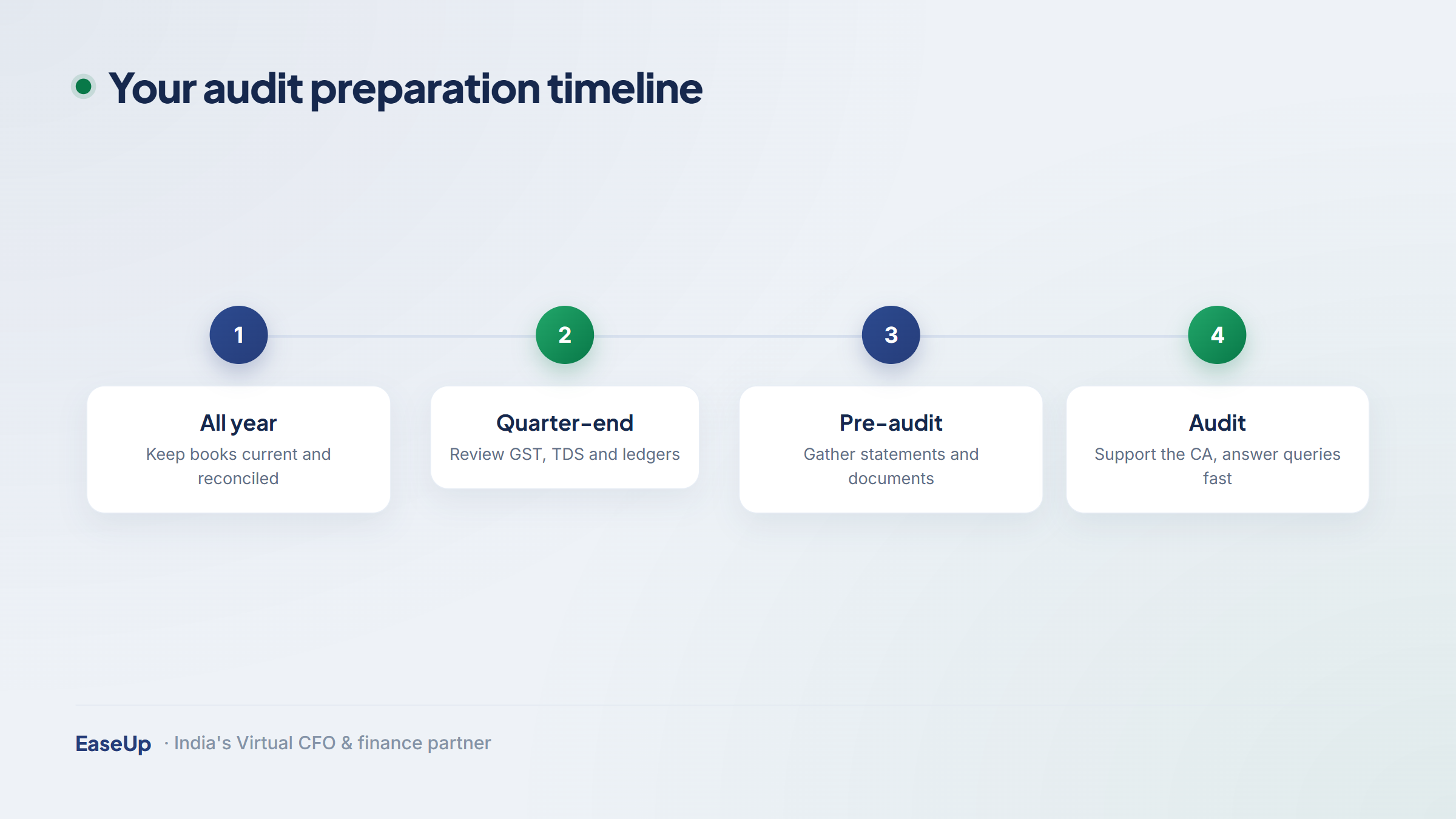
The honest answer: all year. The smart answer: lock a clear timeline so nothing piles up. Most founders leave it too late and then lose a week firefighting.
When | What to do | Why it matters |
Within 30 days of incorporation | Appoint your first auditor and file Form ADT-1 | Required by the Companies Act, 2013 |
Throughout the year | Book entries weekly, save every invoice and challan | No backlog at year-end |
April – May (after 31 March close) | Finalise books, run all reconciliations | Auditor gets clean data |
June – August | Auditor fieldwork and queries | Time to fix gaps calmly |
By 30 September | Approve accounts, finish statutory audit | Stay ahead of filings |
By the tax audit due date (often extended) | File the tax audit report (Form 3CA/3CB-3CD) | Avoid the 271B penalty |
 Watch out: Tax audit and return due dates shift almost every year through CBDT extensions. For FY 2024-25 the tax audit report deadline moved to November 2025. Always confirm the current date on the income tax portal before you plan.
The Master Document Checklist
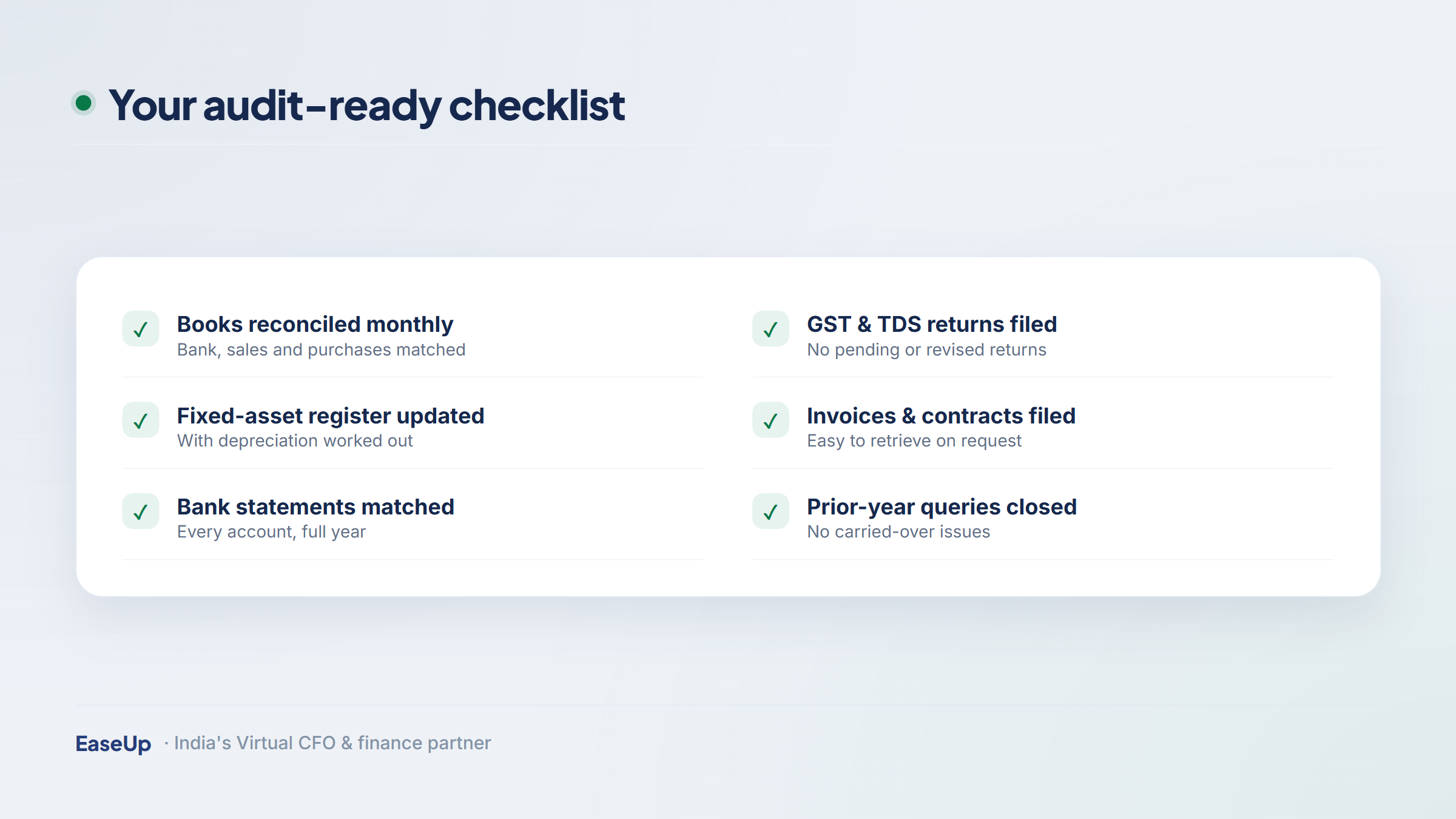
This is the heart of audit prep. Pull these together into one shared folder, sorted by type. If you keep this list ready, your auditor finishes faster and asks fewer questions.
Financial statements. Balance sheet, profit and loss account, and cash flow statement for the year.
Books of accounts. General ledger, cash book, journal, and your full trial balance.
Bank records. Statements for every business account, plus bank reconciliation statements.
Sales and purchase records. All invoices, purchase bills, and expense vouchers, numbered and dated.
GST returns. GSTR-1, GSTR-3B, and GSTR-2B for the year, with a reconciliation to your books.
TDS records. TDS returns (24Q, 26Q), paid challans, and Form 26AS for the business.
Payroll. Salary register, plus Provident Fund (PF) and Employees State Insurance (ESI) challans.
Fixed asset register. A list of assets with purchase dates, cost, and depreciation working.
Statutory records. Board and shareholder meeting minutes, and ROC filings such as AOC-4 and MGT-7.
Loans and related parties. Loan agreements, interest working, and a list of related-party transactions.
The Three Reconciliations That Make or Break Your Audit
If you do nothing else before the auditor arrives, do these three. They catch most errors and save days of back-and-forth.
Bank vs books. Match every line in your bank statement to your books. Chase any cheque or transfer that has not cleared.
GST vs books. Your sales in the books must match your GST returns. A gap here invites a notice from the GST department.
TDS vs Form 26AS. The TDS you deducted and deposited must match what shows in Form 26AS. Fix mismatches before filing.
File your GST returns and check status on the official GST portal. Our financial audit support team runs all three reconciliations as standard.
Cash Rules That Trip Up Founders
Auditors look hard at cash. A few rupee limits cause more disallowances than anything else. Keep these in mind all year, not just at audit time.
Rule | Limit (Rs) | What happens if you break it |
Cash expense to one party in a day (Sec 40A(3)) | Rs 10,000 | The expense is disallowed; you pay tax on it |
Cash received from one party (Sec 269ST) | Rs 2,00,000 | Penalty equal to the amount received |
Cash loan accepted or repaid (Sec 269SS / 269T) | Rs 20,000 | Penalty equal to the loan amount |
:check_mark_button: Founder tip: Pay vendors above Rs 10,000 by bank transfer, UPI, or cheque. It keeps the expense allowed and makes your reconciliation clean.
Startups vs SMEs: What Changes?
The core checklist is the same. But the focus differs depending on your stage.
Startups. Auditors look closely at your funding rounds, share issues, and ESOP accounting. Keep your cap table, valuation reports, and Form PAS-3 filings ready. If you are DPIIT-recognised under Startup India, keep that certificate handy too.
SMEs. The focus shifts to stock and debtors. Keep a clear stock valuation, an aging list of who owes you money, and proof of GST and TDS payments.
Either way, a Virtual CFO keeps these records clean through the year so the audit is a formality, not a fire drill.
Common Mistakes That Slow Down an Audit
Most delays are avoidable. Here are the ones we see again and again.
Starting late. Booking a year of entries in one week leads to errors.
Missing invoices. A cash expense with no bill usually gets disallowed.
Unmatched bank lines. Old uncleared cheques sitting in the books raise red flags.
Mixing personal and business spends. Keep a separate business bank account from day one.
Ignoring related-party deals. Loans from directors or family must be disclosed and documented.
What Happens If You Skip or Delay the Audit?
Skipping a required audit is expensive and risky. The penalties add up fast.
Default | Penalty / consequence |
No tax audit when required (Sec 271B) | 0.5% of turnover, up to Rs 1,50,000 |
No statutory audit / auditor not appointed | Fines on the company and its officers under the Companies Act |
Late ROC filings (AOC-4 / MGT-7) | Rs 100 per day, per form, with no upper cap |
GST reconciliation not filed | Late fees plus possible notices |
Watch out: The ROC late-filing fee of Rs 100 per day has no ceiling. A six-month delay on two forms can cross Rs 36,000. File on time.
Your Quick Pre-Audit Checklist
Run through this list two weeks before your auditor starts. If every box is ticked, you are ready.
Books closed. All entries for the year are booked and the trial balance is final.
Reconciliations done. Bank, GST, and TDS all match your books.
Documents filed. One folder holds invoices, returns, challans, and statements.
Statutory dues paid. GST, TDS, PF, and ESI are all deposited with challans saved.
Registers updated. Fixed asset register and statutory registers are current.
Single point of contact. One person can answer the auditor and pull any file fast.
How EaseUp Makes Audits Painless
We handle audit prep for founders and SME owners across India every year. We close your books, run all three reconciliations, build the document folder, and coordinate with your auditor end to end. You answer a few questions; we do the rest.
Want it off your plate this year? Talk to our financial audit support team, and pair it with ongoing bookkeeping support so next year is even easier.
Start by closing your books and finalising the trial balance. Next, run three reconciliations: bank versus books, GST returns versus books, and TDS versus Form 26AS. Then gather every document into one folder — financial statements, ledgers, bank statements, invoices, GST and TDS returns, payroll records, and your fixed asset register. Finally, confirm all statutory dues are paid and give your auditor a single point of contact. Doing this two to four weeks before fieldwork keeps the audit smooth.
Under Section 44AB, a tax audit is required once your turnover crosses Rs 1 crore in a financial year. If 95% or more of your receipts and payments are digital, that limit rises to Rs 10 crore. For professionals, the limit is Rs 50 lakh of gross receipts. These figures apply for FY 2024-25 (AY 2025-26). Note that registered companies need a statutory audit regardless of turnover.
Ideally you prepare all year by booking entries weekly and saving every invoice and challan. Practically, give yourself a solid head start: finalise your books and run reconciliations in April and May right after the 31 March year-end close, so your auditor can begin clean fieldwork from June. Leaving everything to the last few weeks before the deadline is the most common cause of audit stress and errors.
You will need your financial statements (balance sheet, profit and loss, cash flow), books of accounts and trial balance, bank statements with reconciliations, all sales and purchase invoices, GST returns (GSTR-1, 3B, 2B), TDS returns and challans with Form 26AS, payroll records with PF and ESI challans, a fixed asset register, board and shareholder meeting minutes, ROC filings such as AOC-4 and MGT-7, and details of any loans and related-party transactions.
Under Section 271B of the Income Tax Act, failing to get a required tax audit done attracts a penalty of 0.5% of total turnover or gross receipts, capped at Rs 1,50,000. On top of this, missing statutory audit duties can lead to fines on the company and its directors under the Companies Act, and late ROC filings add Rs 100 per day per form with no upper limit. Filing on time is far cheaper than any penalty.
This article is for general information only and is not professional tax, audit, or legal advice. Rules, thresholds, and due dates change. Please confirm the current position with a qualified Chartered Accountant or with EaseUp before you act.


Your trusted partner for all your Financial needs.


Finance Management
Strategic Services